

What a health tested Labrador puppy costs, and what drives the price, comes down to a short list of line items: the parents' OFA and PennHIP clearances, genetic panel testing, veterinary oversight, and the breeder's overall program investment. Our Lab Puppies come from parents who cleared every one of these tests first.
By Berry Creek Labs, Champion Labrador Breeders
A health tested Labrador puppy's price is built from several line items, not one flat number. The biggest pieces are the parents' OFA and PennHIP orthopedic clearances, a DNA panel for each parent, an eye exam, veterinary whelping and puppy checkups, and the overhead of running a small breeding program: stud fees, quality food, and pedigree matching before a litter is planned. None of that shows up on an untested litter, which is why the two prices differ. Walking through what each line item covers, rather than quoting one number, gets you an honest quote for the puppy you want.
What Health Tests Should Labrador Parents Have Before Breeding?
Labrador breeders generally follow the baseline set by the Labrador Retriever Club's CHIC (Canine Health Information Center) program: hip and elbow radiographs, an eye exam from a veterinary ophthalmologist, and a DNA panel covering the breed's known genetic conditions. Each test carries its own cost, and together they form the floor under a health tested litter's price before a single puppy is born. A dog that fails any of these tests is typically pulled from the program, part of why health tested lines cost more: the breeder has already absorbed the cost of dogs that didn't make the cut.
What Genetic Health Tests Are Recommended for Labrador Retrievers?
The DNA panel typically screens for exercise-induced collapse (EIC), centronuclear myopathy (CNM), progressive retinal atrophy (prcd-PRA), and copper-associated liver disease, a condition increasingly linked to the breed. The same panel usually reports coat color genetics, since the recessive genes behind chocolate Labrador litters are carried on the same DNA and flagged during the same run. A clear panel doesn't guarantee a puppy will never develop a health condition, but it rules out the inherited conditions science can currently identify, more honest than a breeder simply saying their dogs are healthy.
Why Do Health Tested Labrador Puppies Cost More Than Untested Ones?
The price gap comes down to what the breeder spent before the litter existed, not markup on the puppies themselves. Hip and elbow radiographs read by a board certified radiologist, a genetic panel per parent, and an ophthalmologist's eye exam each carry their own fee, paid per breeding dog rather than per puppy sold. An untested pair skips all of it: no radiographs, no DNA panel, no specialist read, no dogs pulled for failing a clearance. That's a real cost difference that shows up honestly in the price rather than in vague language about quality.
There's also a selection cost that's easy to miss. A program that health tests will, over time, remove dogs that carry a flagged gene or fail a hip score, even if those dogs are otherwise lovely companions. Replacing and retesting that dog costs time and money a program skipping tests never spends. Buyers aren't just paying for paperwork, they're paying for a breeder who has already turned away dogs that didn't meet the standard.
What Does OFA or PennHIP Hip and Elbow Testing Involve?
OFA, the Orthopedic Foundation for Animals, and PennHIP, the University of Pennsylvania Hip Improvement Program, are the two accepted methods for evaluating a Labrador Retriever's hip and elbow joints before breeding. Both start with sedated radiographs sent to a specialist for review. OFA grades hips as excellent, good, fair, or a range of dysplastic ratings, and typically won't issue a final rating until the dog is 24 months old. PennHIP can be done earlier, as young as 16 weeks, and reports a distraction index describing joint laxity, which some breeders find more precise and comparable across dogs.
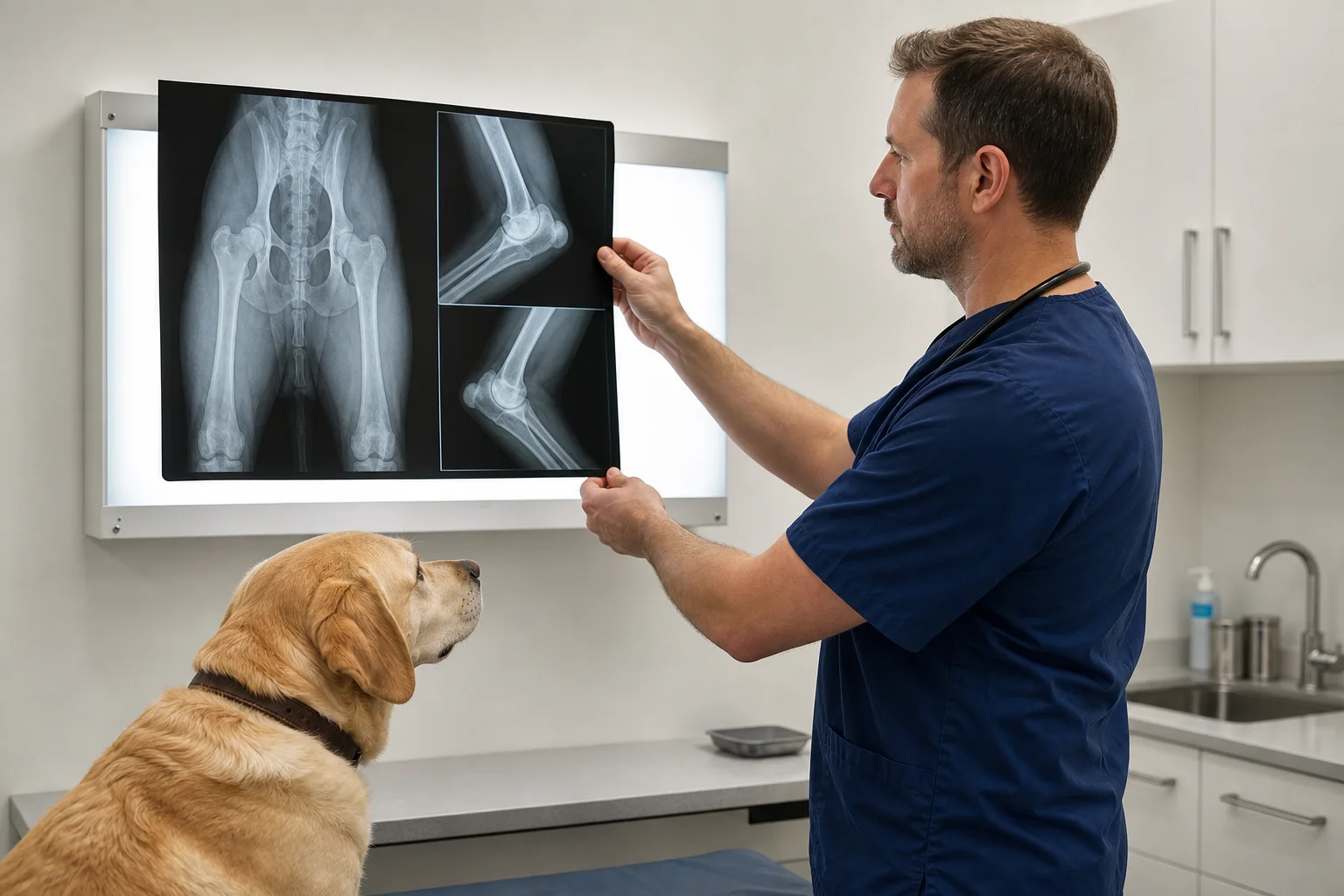
Both are diagnostic services performed by a veterinary specialist, not a general checkup, and both get filed on OFA's public database, where anyone can search a dog's registered name and see the result. That public record turns a breeder's claim into information you can verify yourself.
How Can You Verify a Breeder Actually Health Tested the Parents?
Ask the breeder to provide copies of both parents' OFA certificates, or their registered names so you can look them up on OFA's public database, the same one the wider Labrador community relies on to hold breeders accountable. A breeder who has actually done the testing will hand this over without hesitation, because the results are already public. Be cautious of a breeder who says the parents are health tested but can't produce a certificate number, or who describes a routine vet visit as equivalent to an OFA or PennHIP evaluation, since a checkup doesn't generate a hip score or a DNA panel result. Reputable breeders stay open about test results, including the ones that didn't come back clean, because an honest program removes dogs that fail rather than hiding them.
What Health Clearances Should I Ask a Labrador Breeder For?
At minimum, ask for hip and elbow clearances (OFA or PennHIP), an eye exam within the last twelve months, and a DNA panel covering EIC, CNM, and prcd-PRA. These same baseline questions matter for any first-time Labrador buyer, not just someone shopping a health tested litter, since every buyer needs a way to compare breeders who all claim to be reputable. Ask for the actual certificate numbers rather than a verbal assurance, and treat a breeder who can't produce them the same regardless of price.
Is Paying More for a Health Tested Labrador Puppy Worth It in the Long Run?
What a health tested Labrador puppy costs, and what drives the price, usually pays for itself the first time it prevents a major veterinary bill. Hip dysplasia, luxating patellas, and inherited eye disease are expensive to treat and can shorten or limit a dog's active life, while a clear DNA panel rules out several conditions a Labrador cannot outgrow. Labradors are also statistically prone to certain cancers later in life, and while no panel rules out cancer risk entirely, breeders who health test tend to also track longevity across their lines, another honest data point worth asking about.
For a family planning to keep a dog for its whole life, hunt with it, or bring it into an active household, the difference shows up in years of soundness rather than a single vet visit. A dog free of inherited joint pain stays a willing hiking, swimming, or hunting partner longer. Buyers who want to see what a current, verified litter looks like can start with our Upcoming Litters page rather than guessing from a price alone.
Frequently Asked Questions
What is the average price range for a health tested Labrador puppy?
Price varies by region, bloodline, and how extensive the parents' clearances are, so any single number quoted online will be wrong for a specific litter. What holds steady across reputable programs is the structure: OFA or PennHIP hip and elbow scores, an eye exam, and a DNA panel built into the price before you ever ask. The most accurate way to know your number is to ask a specific breeder for a quote tied to a specific litter.
What is the difference between health tested and health guaranteed puppies?
Health tested means the parents were screened for known conditions before breeding: OFA or PennHIP, an eye exam, and a DNA panel, with documented results. A health guarantee is a separate, contractual promise covering what happens if a specific condition shows up after purchase. A breeder can offer one without the other, so ask to see both: the parents' actual test results, and the written guarantee language.
Do all reputable Labrador breeders health test their dogs?
Reputable breeders who are serious about the breed's long-term health generally do, and most will point you to their dogs' OFA records without being asked twice. That said, reputable is not a protected term, so testing is a more reliable signal than reputation alone. If a breeder can't produce clearance paperwork for both parents, treat that as a real gap to ask about directly.
How much does it cost a breeder to health test a breeding pair?
It adds up across several separate services: hip and elbow radiographs plus a specialist's read, a DNA panel per parent, and an ophthalmologist eye exam, each billed independently rather than as one bundled fee. Breeders also absorb the cost of dogs that fail a clearance and get pulled from the program. That combined cost is the single biggest reason health tested litters are priced differently from untested ones.
Get a Straight Answer on Your Puppy's Price
The clearest way to know what a health tested Labrador puppy costs, and what drives the price for a specific litter, is to ask the breeder directly and request the paperwork behind the number. Contact our team during regular business hours and we'll walk you through every clearance behind our current litters.